About
Qixia Luo
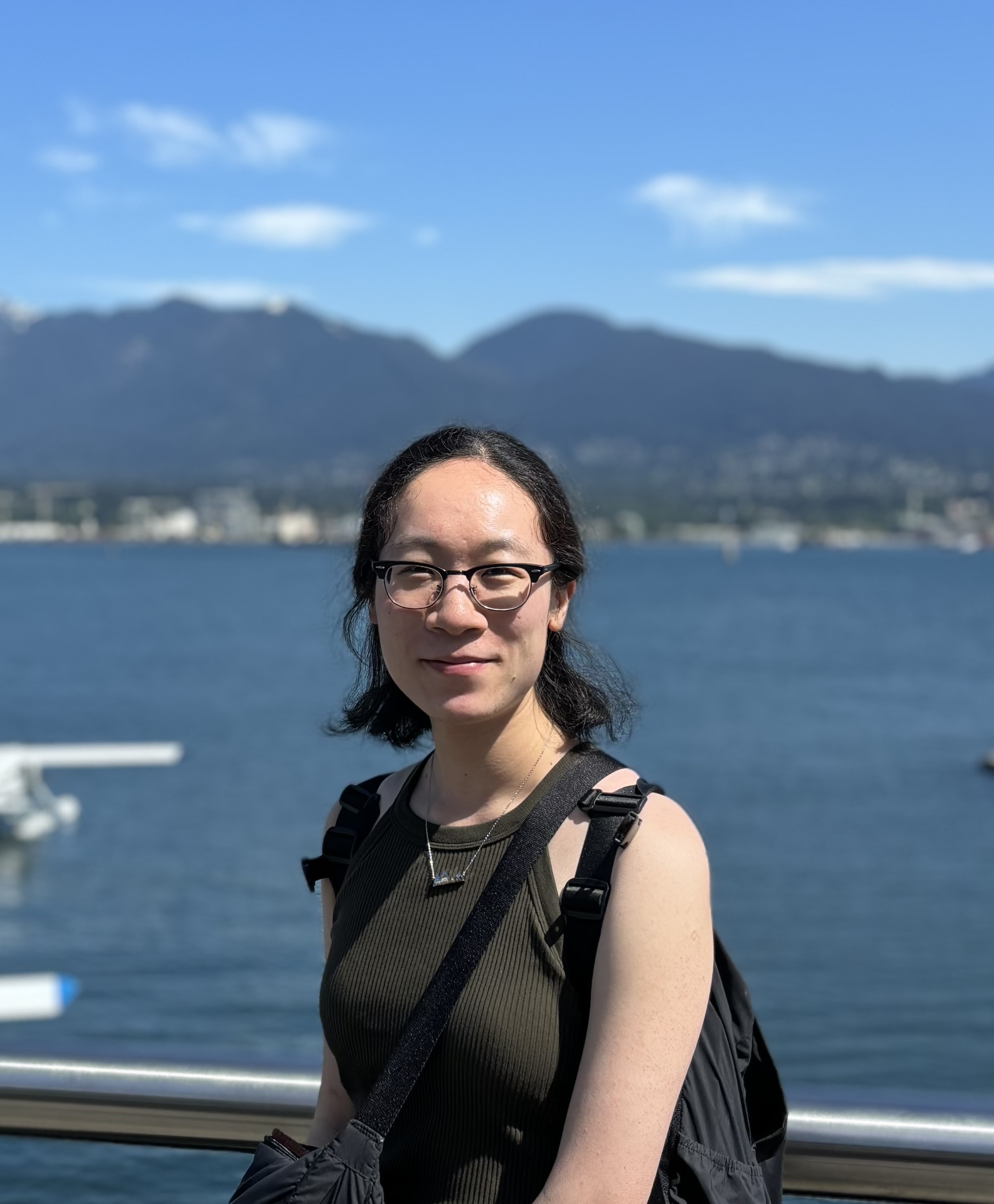
I am currently a PhD student in the Department of Mathematics and the Institute of Applied Mathematics at The University of British Columbia in beautiful Vancouver, British Columbia. I am working with Prof. Elina Robeva on algebraic statistics and mathematical questions related to data science.
In July, 2025, I obtained my MSc from the Department of Mathematics and Statistics at Queen's University at Kingston, where I worked with Prof. James A. Mingo on free probability and random matrix theory.
In June, 2022, I obtained my Honours BSc from the University of Toronto, where I graduated with honours and high distinction in mathematics and statistics.
Summer Reading Program
Finite Frames SRP 2026
This page is reserved for material, schedule, and other information for the Finite Frames SRP 2026 project.
The Summer Reading Program (SRP) at UBC is a program for undergraduate students who are interested in learning a topic in math beyond the standard undergraduate curriculum. Each summer, selected undergraduate students are matched with mentors who are graduate students or postdoctoral researchers at UBC. For more information, see UBC MATH SRP.
This summer, I have decided to create a group to learn about finite frames, which is a fascinating area of mathematics that lies at the intersection of several areas of math that is currently undergoing active research, with exciting applications to many areas such as signal processing, quantum information theory, and data science, to name a few.
The reason for the focus on finite frames is twofold.
- In practical applications, we always work with finite-dimensional spaces.
- Since functional analysis is not a prerequisite for participation in this reading program (participants are in years 1-3 of their undergraduate studies), studying frames in the finite dimensional setting is the accessible way to introduce them to this subject.
Despite the restriction to the simplified finite-dimensional setting, we will still be able to go surprisingly far. The participants will write a report or do a presentation on a cutting-edge topic at the end of the program.
The basic content of the reading program will be guided by the following two books:
- Frames for Undergraduates (Han, Kornelson, Larson, Weber, 2007)
- Finite Frames: Theory and Applications (Casazza, Kutyniok, 2013)
- An Introduction to Frames and Riesz Bases (Christensen, 2003)
Schedule
-
Week 1
Readings: Sections 3.1, 3.2, and 3.3 in Frames for Undergraduates.- June 1: Introductions. Overview and expectations of the reading program. Review of linear algebra concepts (hilbert spaces, bases, orthonormal bases, orthogonal complement, rank). Frames as objects that generalize orthonormal bases. First definition of a finite frame. Equivalent deinfitions of a finite frame. Parseval frames.
- June 5: Reconstruction formula for Parseval frames. Uniform frames. Property of the norm of vectors in a Parseval frame. Mercedez-Benz frames. Definition of a general frame (works for finite or infinite dimensions). (Optimal) frame bounds. Triviality of the upper frame bound.
Readings: 3.4 and 3.5 in Frames for Undergraduates and Section 1.9 in An Introduction to Frames and Riesz Bases.- June 8: Equivalence of the general frame with finite frames in finite dimensions (future participant presentation). Tight frames. Review of the adjoint of an operator. Operators associated with a frame and their properties: Analysis operator, synthesis operator, and frame operator. Reconstruction formula for frames and how this generalizes the reconstruction formula for Parseval frames. Dual frames and the canonical dual frame.
- June 12: Redundancy. Eigenvalues of the frame operator. Application of tight frames for noise supression in signal transmission.
Readings: Sections 3.5, 3.6, 5.1 in Frames for Undergraduates- June 15: Definition and properties of postive operators and matrices. Definition and properties of similar operators and matrices. Square root of a positive operator or matrix. Similarity and unitary equivalence of frames. Every frame is similar to a Parseval frame. Two parseval frames are similar iff they are unitarily equivalent. Two frames are similar iff their analysis operators have the same range (proof will be a future participant presentation).
- June 19: Felix's presentation on the equivalence of R^n frames and general frames in finite dimensions. Special properties of tight frames. Frame potential. Proof of unit tight frames are exactly those that minimize the frame potential. Numerical algorithms for reconstruction that avoids inversion of frame operator.
Readings: Sections 5.2, 5.3, 6.1 in Frames for Undergraduates- June 22: Angela's presentation on orthogonal compression of frames. Oblique projections. Oblique compressions. Oblique projections of a orthonormal basis onto a subspace is a frame with frame bound greater than or equal to 1 (converse is not true!). Characterization of frames that can arise as the oblique compression of an orthonormal basis.
- June 26: Lily's presentation on the proof of two frames being similar iff the range of their analysis operators being the same. Dual frame, canonical dual frames, alternate dual frames. Uniqueness of dual frame. Biorthogonality of basis and its canonical dual. Uniqueness of dual characterizes bases.
Readings: Sections 6.2, 6.3 in Frames for Undergraduates- June 29: Vincent's presentation on the proof of tight frames achieving minimal frame potential. Characterizations of the duals of a frame. Argument using matrices for when a frame is not a basis, then it has infinitely many duals. The canonical dual is the only dual that is similar to the original frame. Canonical duals minimize a certain special quantity.
- July 3: Brenden's presentation on dilation of frames.
Readings: Sections 6.4, 6.5 in Frames for Undergraduates- July 6: There was no meeting on this day.
- July 10: The Canonical dual of the canonical dual is the original frame. Orthogonal sequences and orthogonal frames. characterizing orthogonal sequences in terms of the analysis and synthesis operators. Two parseval frames are orthogonal iff their direct sum sequence is a parseval frame for the direct sum space. Direct sum of two orthogonal frames is a frame for the direct sum space. Orthogonal frames have a common dual.
Readings: Section 6.6, 7.1 in Frames for Undergraduates- July 13: Disjoint frames and how they generalize orthogonal frames. Sum of frames need not be a frame. Exercise 13 of Chapter 6. Sum of two disjoint frames is a frame. Two frames are disjoint iff their direct sum sequence is a frame for the direct sum space. Multiplexing.
- July 17: There was no meeting on this day.
Readings: Section 7.2, 7.3 in Frames for Undergraduates- July 20: Ellipsoids (especially the characterization of them as the image of the unit sphere under a positive definite operator). Ellipsoidal tight frames. Rank 1 matrices and tensor products. Positive definite operators in terms of a sum of rank one orthogonal projections. Continuity of eigenvalues. Existence of ellipsoidal tight frames with any number of vectors (as long as this number is larger than the dimension of the ambient Hilbert space).
- July 24: There was no meeting on this day.